

Artificial Grass in Anna, TX
Anna is at the north edge of our primary service territory, and it has been interesting to watch the city change over the last decade. What was a small agricultural town is now a full suburb attracting families from further south who want more space and a lower price point. The newer subdivisions in Anna carry the same construction-soil challenges we see in Melissa and Celina — compacted clay from development activity, builder sod that struggles through the first couple of summers. The families who call us in Anna are typically a year or two into homeownership, frustrated that their yard has not worked out the way they hoped, and ready to do something that will actually last. We understand that situation and we know how to solve it.
Get a Free On-Site EstimateLocal Service in Anna
Anna is at the north edge of our primary service territory, and it has been interesting to watch the city change over the last decade. What was a small agricultural town is now a full suburb attracting families from further south who want more space and a lower price point. The newer subdivisions in Anna carry the same construction-soil challenges we see in Melissa and Celina — compacted clay from development activity, builder sod that struggles through the first couple of summers. The families who call us in Anna are typically a year or two into homeownership, frustrated that their yard has not worked out the way they hoped, and ready to do something that will actually last. We understand that situation and we know how to solve it.
What makes Anna's soil different from the southern parts of Collin County?
Anna sits in the upper Collin County drainage basin where the soils transition gradually from the heavy Blackland Prairie clay of the southern county to a somewhat lighter clay-loam mix. The practical difference for turf installation: the native soil in Anna has marginally better percolation than in Plano or Allen, but it is still far from free-draining. After construction activity, whatever natural drainage characteristics the soil had are disrupted anyway.
The second soil characteristic we note in Anna is a tendency toward a caliche hardpan layer at varying depths. In parts of Anna's older agricultural land, there is a calcium carbonate hardpan sitting 8 to 14 inches below grade. If our excavation hits that layer, it creates a containment vessel for water. We probe for the hardpan before we spec the base depth — if it is within our excavation zone, we either go through it with a breaker bar at the drainage outlet point or we engineer around it with a lateral drainage channel that moves water horizontally before it hits the hardpan.
This is detail work, but it matters. One of the most common callbacks we see on lower-cost installs in this part of Collin County is a base that holds water because nobody tested for the subsurface conditions. We test every site.
What should Anna pet owners know about summer heat and synthetic turf?
Anna is exposed. The open North Collin County landscape means less tree cover than you find in established Plano or Allen neighborhoods, and less tree cover means more direct sun on the yard surface. This makes the surface temperature question more relevant in Anna than in some other parts of our market.
For Anna pet yards in open sun exposure, we make two adjustments from our standard spec. First, we use a light-colored infill — either a coated silica sand or a blend of light tan crumb rubber — rather than black rubber. The color difference reduces surface temperature measurably on a July afternoon. Second, we select a blade color in the medium olive range rather than a deep emerald. Darker green pigments absorb more solar energy; lighter olive shades reflect more. The combination of light infill and lighter blade color keeps the surface temperature in a range where barefoot use is comfortable through most of the afternoon.
The quick-rinse habit matters in Anna too. Running a garden hose over the turf for 60 seconds before afternoon dog time drops surface temperature significantly and lasts for 45 to 60 minutes. Most Anna families figure this out on their own after the first summer, but we mention it up front so they are not surprised by a warm surface in July.
Does artificial turf make sense on the tight lots in Anna's newer subdivisions?
Anna's newer subdivisions vary in lot size, but many of the recent developments are delivering homes on 50 to 60-foot-wide lots with relatively modest backyard depths. On a 1,000 to 1,200-square-foot backyard, the cost-benefit calculation for synthetic turf actually gets stronger than on a larger lot — you are covering the entire usable yard, which means the performance benefit is total rather than partial.
Tight Anna lots also benefit from turf because the natural grass challenges are proportionally more severe. Dogs in a small yard concentrate their traffic on a limited surface area, which means a natural grass yard in a tight Anna lot can be completely destroyed within a single season of two-dog use. The small area that would take 50 dogs to stress on a half-acre lot only takes two dogs to stress on 1,000 square feet.
For tight lots, we also discuss the drainage outlet options carefully. On a small Anna backyard, there may only be one viable drainage exit. We design the base grade to get all water to that one exit efficiently, and we make sure the exit can handle a storm event without backing up. Sometimes that means a simple gravel sump at the fence line; sometimes it means a short run of perforated pipe to a yard drain connection. The lot size determines what is feasible.
What is the typical maintenance commitment for an Anna turf yard?
We tell every Anna client the same thing about maintenance: it is genuinely simpler than natural grass, but it is not zero. Here is what the actual annual routine looks like for a pet yard.
Monthly: hosing down the pet-use areas to rinse surface residue and cool the infill. Takes five to ten minutes. You were going to water the yard anyway with natural grass — this is far less water for a specific purpose.
Quarterly: leaf blowing or raking if you have trees nearby. Anna has fewer mature trees than southern Collin County communities, so leaf load is lower for most yards. But any organic debris that accumulates in the pile should come off before it decomposes into the infill, which causes odor.
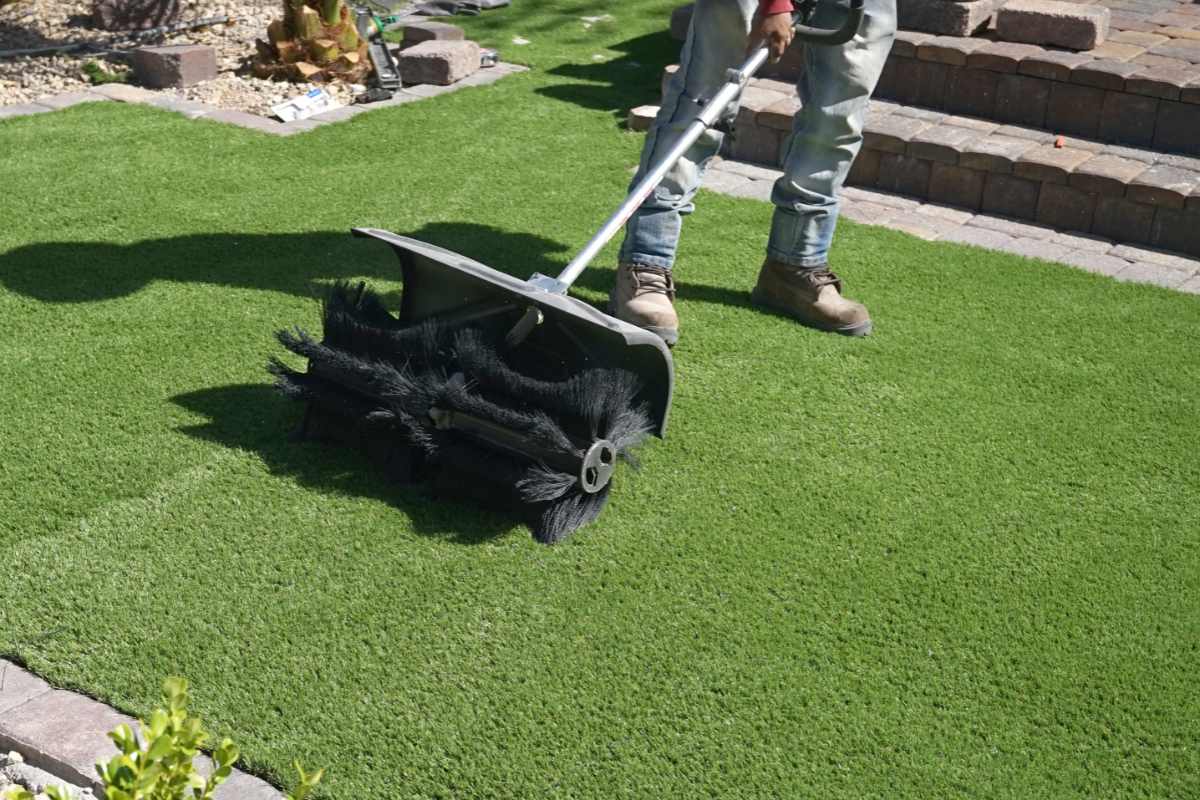
Annually: power brooming to restore blade upright position and redistribute infill that has shifted toward the perimeter from foot traffic. This is a 30 to 45-minute job on a typical Anna backyard. We offer an annual maintenance service, or you can rent or purchase a stiff-bristle power broom and do it yourself.
Every three to five years: zeolite infill top-dress if you have dogs. The zeolite's ammonia-capture capacity gets saturated over time. A top-dress refreshes it. This is our maintenance service and takes about two hours on a standard-size yard. Not expensive, and it keeps the odor management working at full capacity.
That is the honest maintenance picture. We are not going to tell Anna clients that turf is completely zero-effort because it is not. It is dramatically less effort than natural grass, but it works best for people who are willing to do the minimal routine described above.
What does an Anna install look like in practice?
Most Anna residential backyards complete in three to four working days. We schedule morning starts to take advantage of cooler morning temperatures for the physical work.
Pre-install we run a 811 utility locate — this is non-negotiable on every job. In newer Anna subdivisions, there are often gas lines, communication conduits, and irrigation systems that were not mapped cleanly by the builder. We locate everything before we excavate.
Day one: Excavation and demo. Existing sod removed, soil excavated to depth, material hauled off. Subgrade test for uniformity and any subsurface surprises.
Day two: Base installation. Granite in, compacted in two passes, drainage structures installed, final grade confirmed. Weed barrier membrane installed between subgrade and granite.
Day three: Turf installation. Roll, cut, seam, nail. Edge transitions at all hard surfaces — concrete, block walls, wooden fence bases.
Day four: Infill, brooming, walkthrough. We do the final walkthrough with you present, pointing out seam locations and asking you to verify they meet your expectations before we pack the truck. We leave a one-page care guide with seasonal notes specific to North Collin County.
Services Available in Anna
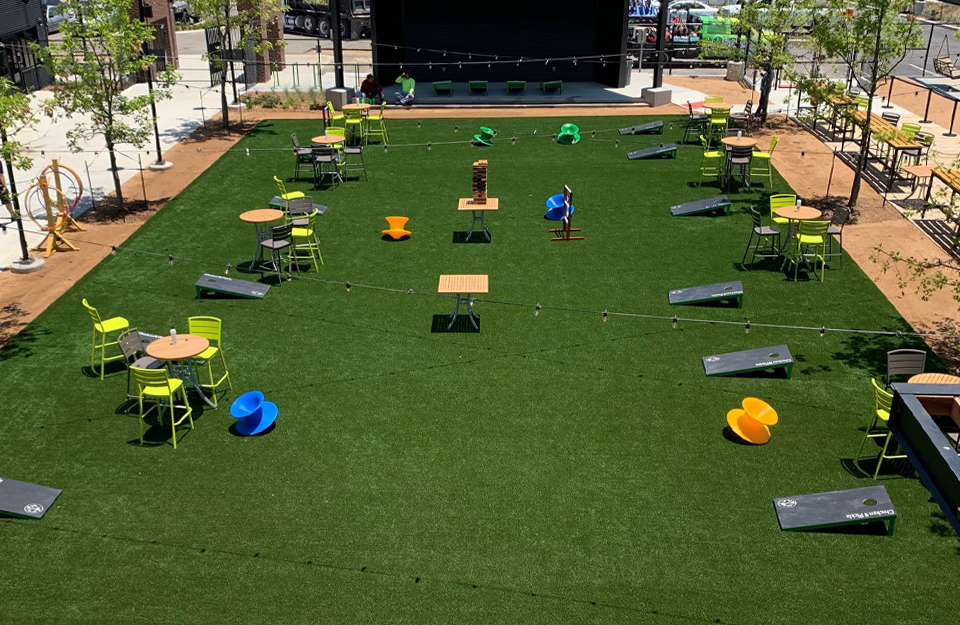
Commercial Artificial Grass Installation
Professional Commercial Artificial Grass Installation in Allen, TX.
View Service
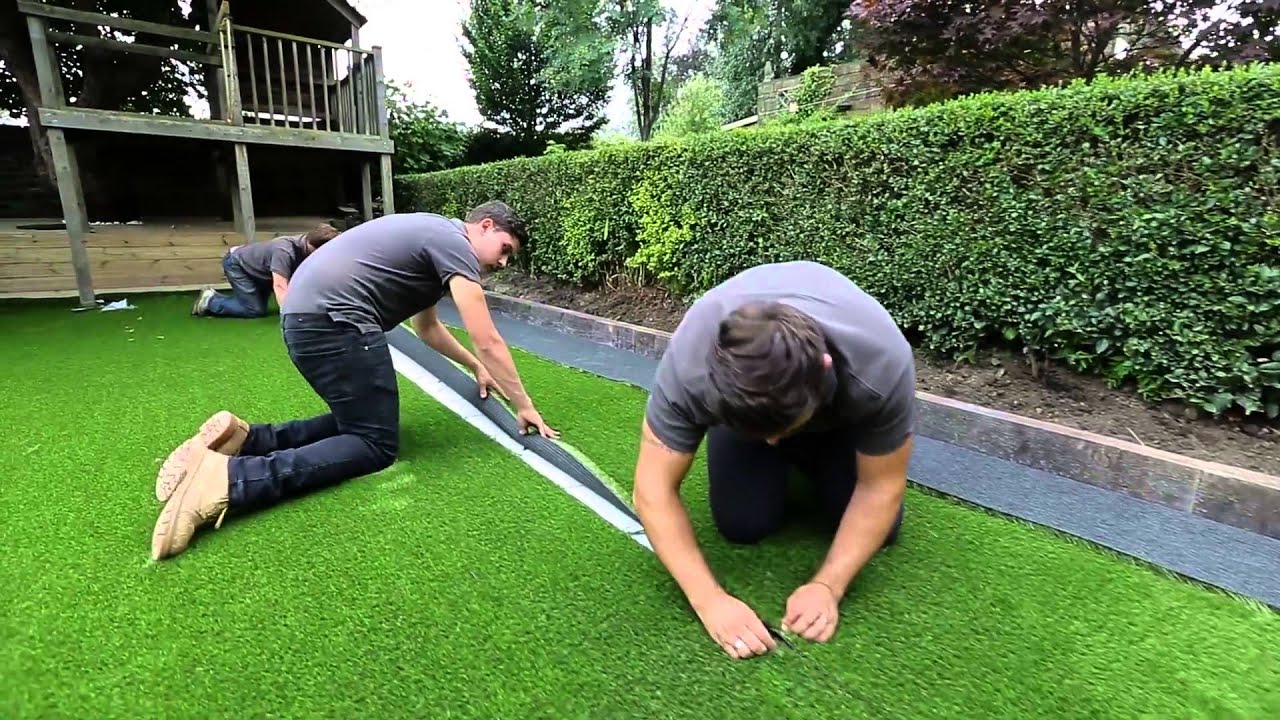
Residential Artificial Grass Installation
Professional Residential Artificial Grass Installation in Allen, TX.
View Service
Artificial Grass Putting Green Design
Professional Artificial Grass Putting Green Design in Allen, TX.
View Service
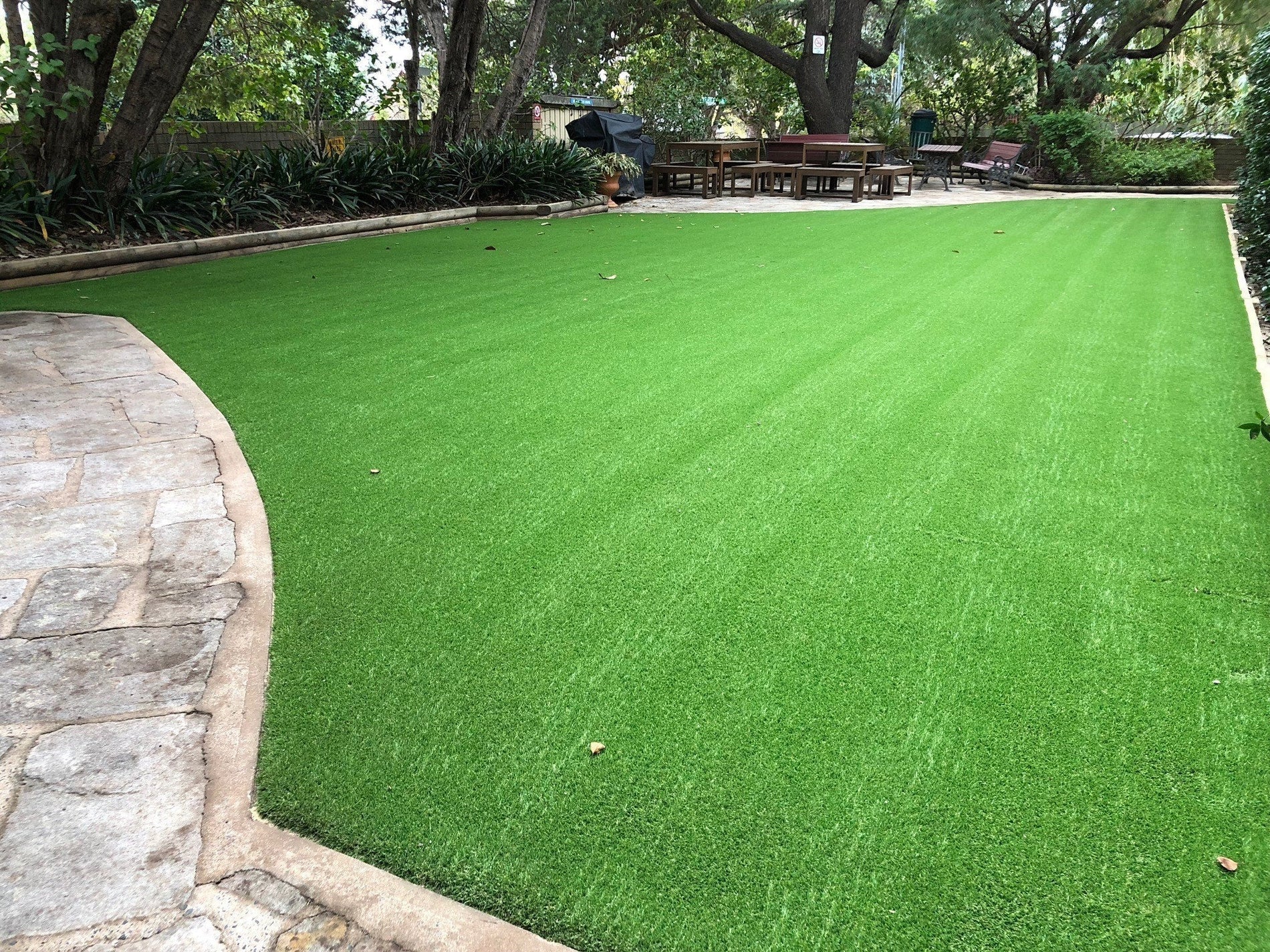
Artificial Grass Maintenance
Professional Artificial Grass Maintenance in Allen, TX.
View Service
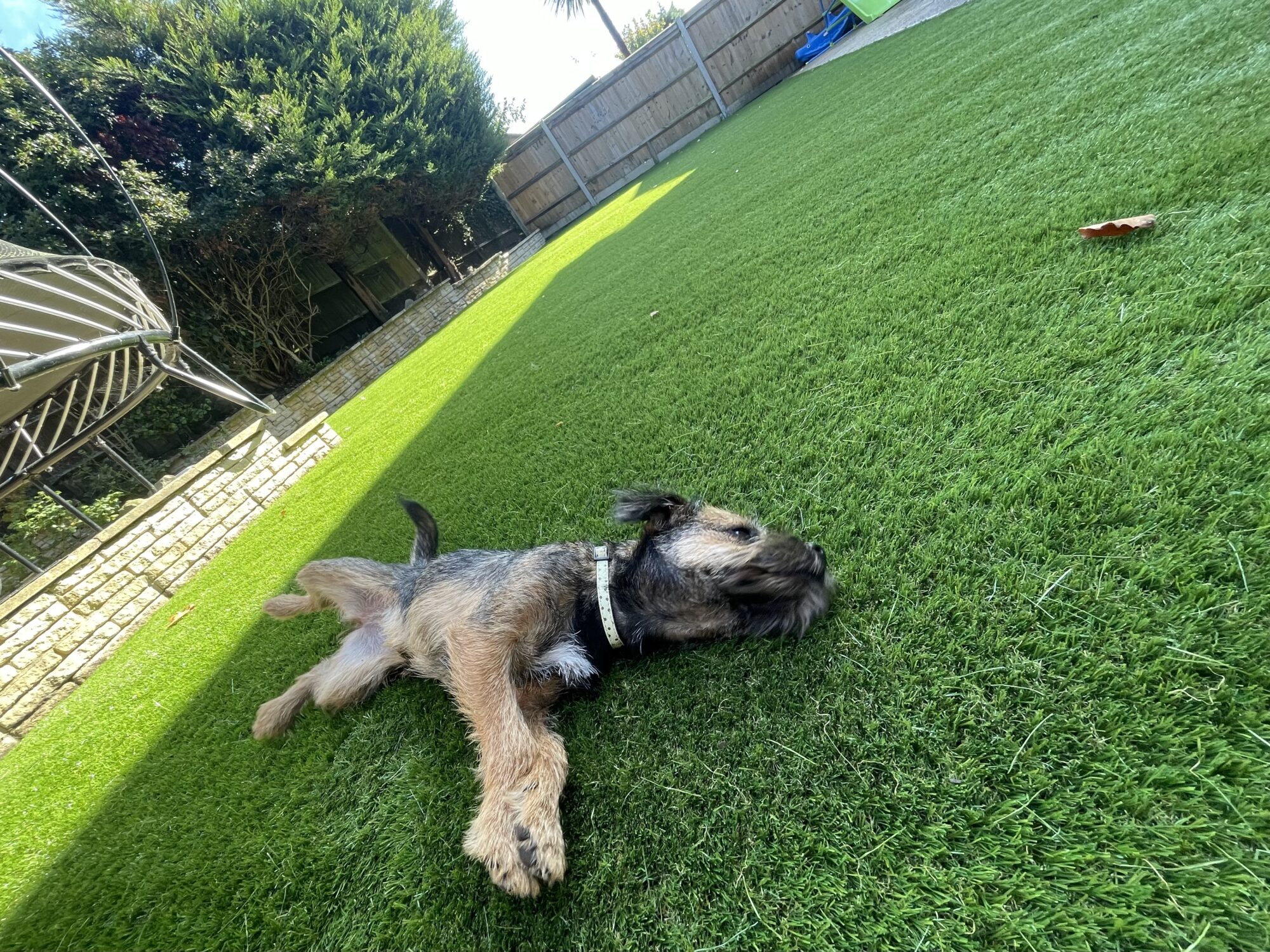
Artificial Grass For Pets
Professional Artificial Grass For Pets in Allen, TX.
View Service
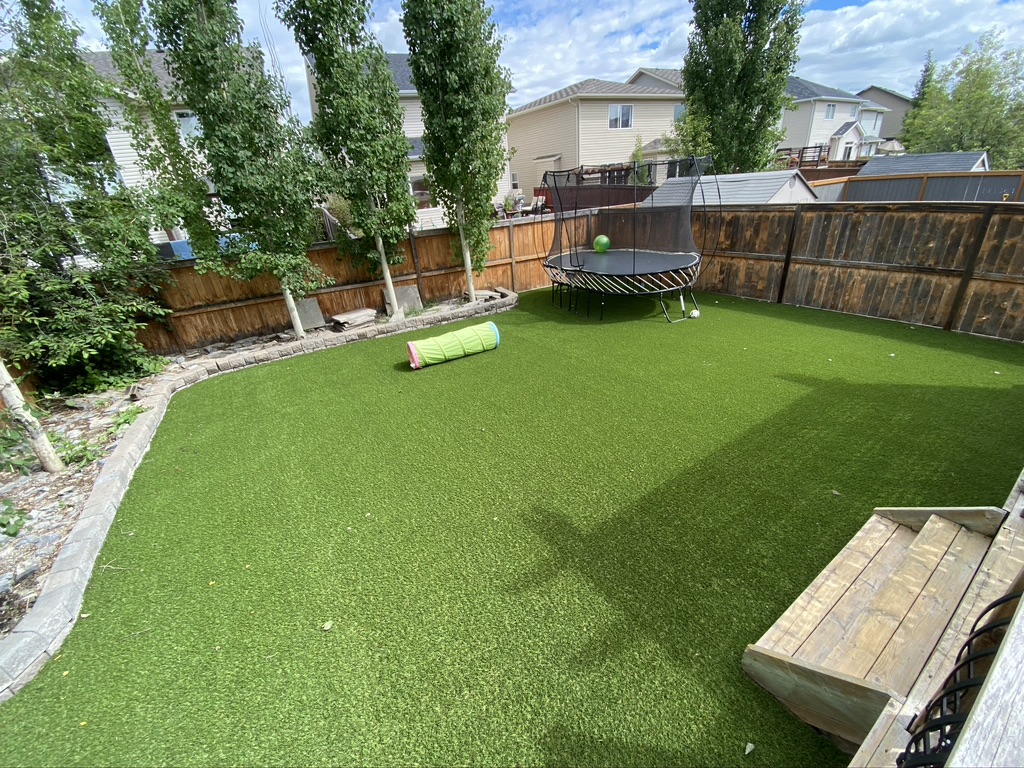
Artificial Grass Repair
Professional Artificial Grass Repair in Allen, TX.
View Service
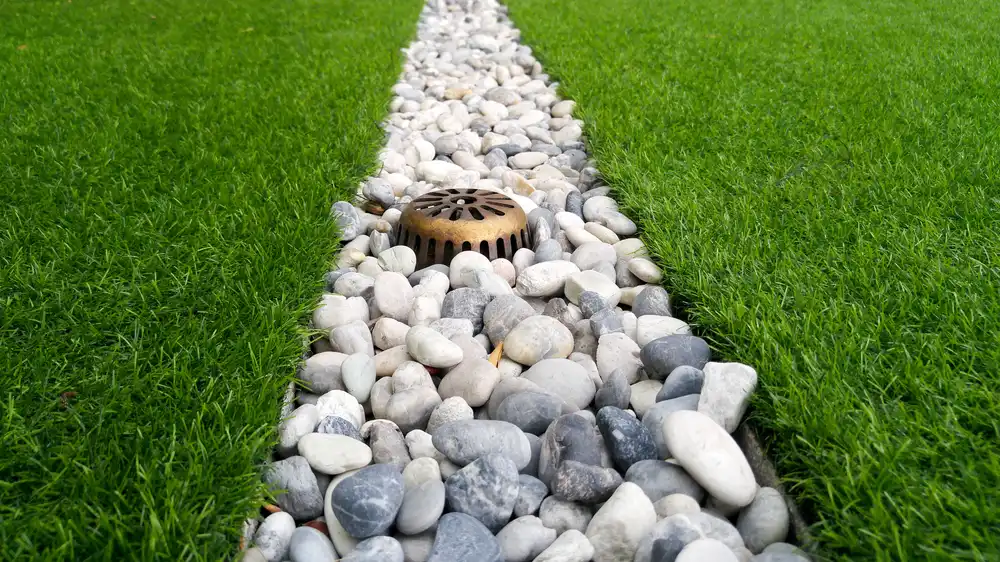
Artificial Grass Drainage Solutions
Professional Artificial Grass Drainage Solutions in Allen, TX.
View Service
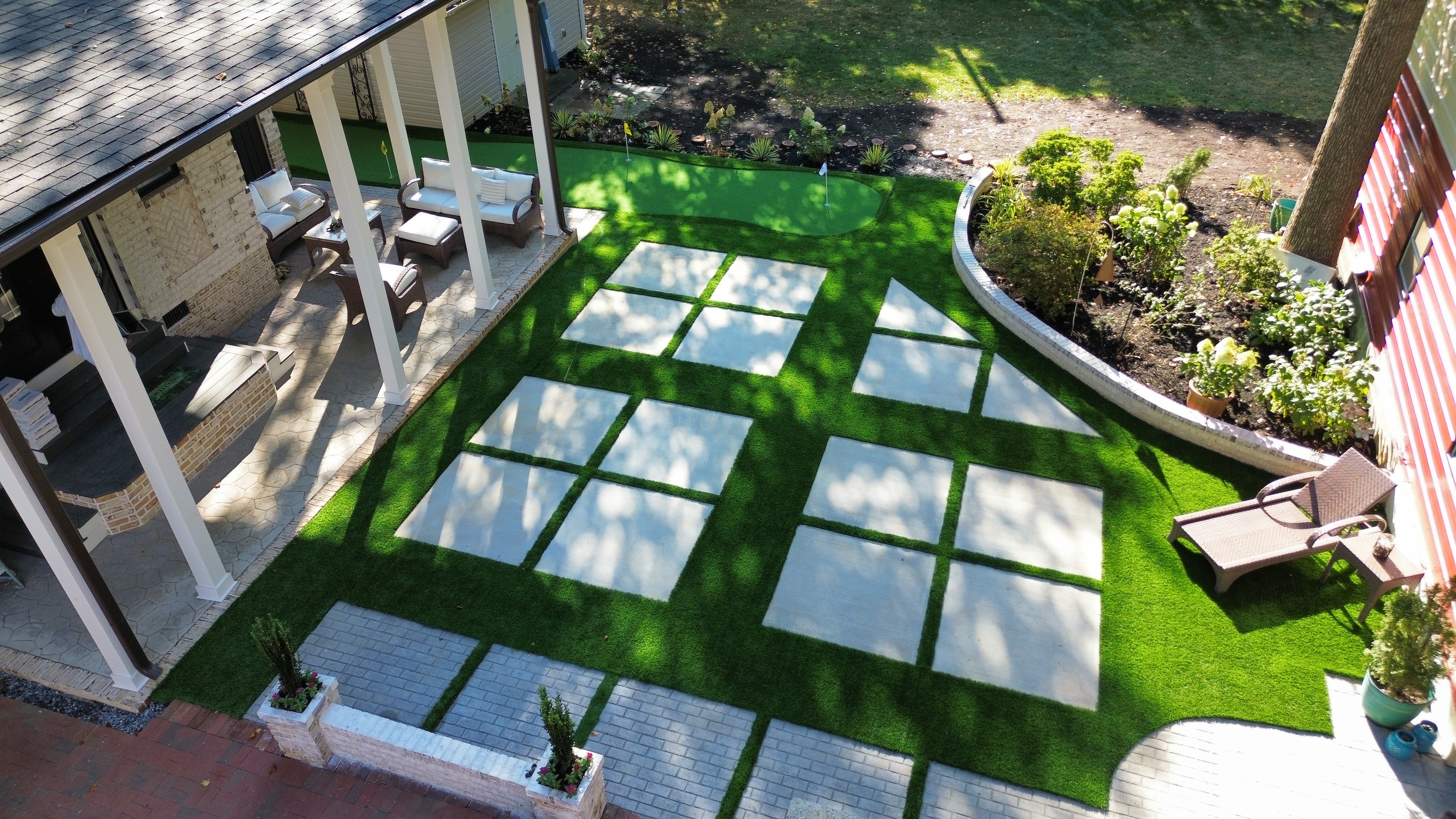
Artificial Grass Consultations
Professional Artificial Grass Consultations in Allen, TX.
View Service
Artificial Grass Removal And Replacement
Professional Artificial Grass Removal And Replacement in Allen, TX.
View Service
Nearby Cities We Serve
Anna yard questions? Let's talk.
Anna TX artificial grass installs for pet families in North Collin County. Drainage-smart base, pet-safe infill, no boilerplate. Local crew with 18 years experience.
Get a Free On-Site Estimate