Artificial Grass of Allen
Artificial Grass Drainage Solutions

Artificial Grass Drainage Solutions in Allen, TX

The turf is the finish layer. The drainage is what makes or breaks the installation.

Why drainage is more complicated in Allen than most contractors admit

We have been doing drainage work in Allen and Collin County for eighteen years, and the consistent lesson is this: most synthetic turf failures are drainage failures. The turf product itself is fine. The base design or drainage outlet is not. We handle drainage both as part of new installations and as retrofits for existing turf systems that were installed without adequate drainage planning.

Allen sits on Blackland Prairie clay — one of the worst-draining soil types in the country for residential landscaping. Water applied to that clay at any rate above about 0.1 inches per hour simply stays on the surface. That is why Allen yards pond after rain, and it is why a synthetic turf installation on that clay without an engineered base is just creating a synthetic-looking pond.

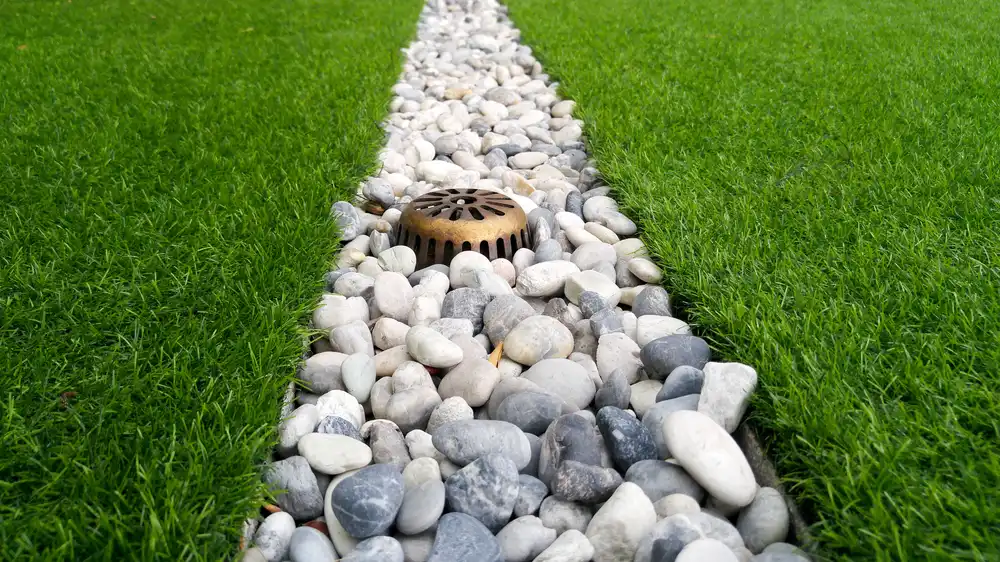
The crushed granite base we use in every installation drains at roughly 30 inches per hour — 300 times faster than the native soil. But that fast-draining base has to have somewhere to send the water. An exit point. If the base drains fast and the exit point is insufficient — too small, blocked, or simply absent — the base fills up from the bottom and you have the same water retention problem, just a few inches lower in the ground.

Artificial Grass Drainage Solutions

What proper drainage design does for an Allen turf installation

We talk about drainage at the beginning of every client relationship because the performance gap between a drained and undrained installation is significant.

Surface dries in minutes rather than hours after rain

A properly drained installation in Allen clears within 20 to 40 minutes after a normal rain event. Properly drained means the base drains freely and the exit point handles the volume. This is the drainage performance most people imagine when they see synthetic turf marketed as fast-draining. It is achievable, but it requires engineering the exit point, not just choosing a permeable turf product.

Pet yard odor management depends on drainage

Zeolite infill manages ammonia effectively only when the liquid passes through it and drains out. If the base is saturated and liquid does not move, it pools around the zeolite particles without being processed. A pet yard with standing water issues will develop odor regardless of infill selection. Drainage is the prerequisite for odor control in a pet installation.

Base structure stays intact through wet-dry cycles

North Texas soil expands when wet and contracts when dry. Clay soil goes through this cycle repeatedly through the spring and fall seasons, and the dimensional change is measurable. A turf base sitting in undrained clay is exposed to that expansion pressure from below. Proper drainage keeps the base dry, which keeps the clay below it in a more stable state and prevents the base heave that causes surface undulation.

Prevents the secondary mold and odor issues of standing moisture

Standing moisture under turf in a warm climate — Allen from April through October — creates conditions for mold and bacterial growth in the backing. Both affect the smell of the yard and the long-term condition of the backing material. Dry drainage keeps the backing environment hostile to mold.

How we assess and solve drainage problems in Allen

Drainage work starts with observation and ends with an engineering decision. We do not guess at drainage solutions.

Step 1

Site hydrology walk

We visit the property after rain if possible, or we ask the homeowner to describe water behavior in detail. Where does water collect? How long does it stay? Does it move or does it sit? These observations determine the drainage category — standard, enhanced, or engineered.

Step 2

Soil probe and subsurface assessment

We probe the subgrade with a penetrometer to identify clay concentration, compaction layer depth, and any subsurface hard layers (caliche, dense fill) that could create a perched water table under the base.

Step 3

Exit point identification and sizing

Every drainage system needs an exit. We identify the viable exits on the property — existing yard drains, storm connections, natural grade to a swale, or a gravel sump — and we size the drainage system to deliver water to that exit at a rate the exit can handle.

Step 4

Drainage infrastructure installation

Based on the assessment: standard crushed granite base, enhanced base with dimple-board mat, catch basin installation, perforated pipe French drain, or a combination of these. We install what the site actually needs, not a one-size solution.

Step 5

Drainage test before turf installation

Before we unroll any turf, we test the drainage system by flooding the base area and observing how the water exits. If it does not drain to specification, we address the issue before the turf covers it. This step is not optional.

Service Areas

Artificial Grass Drainage Solutions projects commonly support properties in Allen, TX, Mckinney, TX, Frisco, TX, Plano, TX, Fairview, TX, Lucas, TX, Wylie, TX, Parker, TX, Princeton, TX, Melissa, TX.

Drainage questions from Allen homeowners and turf owners

I already have synthetic turf but water pools on it after rain. What do I do?

This is a drainage retrofit situation. We assess the existing installation — probe the base through the turf surface, check the drainage exit, and determine whether the issue is base compaction failure, drainage exit blockage, or inadequate original design. In most cases, we can install drainage infrastructure with minimal turf disturbance. In some cases, we need to lift a section of turf, add infrastructure, and re-lay. We tell you which situation you are in after the on-site assessment.

How do you handle drainage for an Allen backyard with no existing storm connection?

Most Allen residential lots without an in-ground storm connection can use a gravel sump drainage system. This is an excavated area at the natural low point of the yard, filled with open-graded aggregate and wrapped in geotextile fabric. The sump accepts drainage from the turf base and releases it slowly into the surrounding native soil. For most Allen lots, a properly sized sump handles normal rain events without backing up. For properties with very heavy clay and no natural outlet, we occasionally need to extend a drain line to the street curb — this requires a trench across the yard and a PVC line, which adds cost and time.

Does the dimple-board drainage mat actually make a difference, or is it a upsell?

It makes a real difference on sites with heavy clay and limited drainage slope. The dimple board creates a horizontal drainage plane between the native soil and the granite base, allowing lateral water movement even when the soil below it has essentially zero percolation. On a flat Allen backyard with waxy clay, it can be the difference between a 20-minute drain time and a 4-hour drain time. On a property with some natural slope and lighter clay, the standard base without dimple board drains adequately. We recommend it where the site conditions justify it, not on every installation.

Do I need to worry about drainage for a small front yard installation?

Front yards in Allen are often sloped toward the street, which naturally drains most of the water. For a standard sloped front yard, the crushed granite base drains effectively toward the curb and drainage is not a significant concern. Where we do flag front yard drainage is on flat lots, on lots with a negative slope toward the house, or on properties where the front yard is low relative to the driveway. Those situations need specific drainage attention regardless of installation size.

Drainage issue? Let's figure out what is actually happening.

If your Allen yard ponds after rain or your existing turf is holding water, an on-site assessment will tell you exactly what the cause is and what it takes to fix it.