Artificial Grass of Allen
Artificial Grass Putting Green Design

Artificial Grass Putting Green Design in Allen, TX

Custom practice greens for Allen-area golfers who want to work on their short game without driving to a course.

What makes a backyard putting green actually playable in Allen

We have been designing and installing backyard putting greens in Allen and across Collin County for over a decade. The work is different from standard lawn turf — the surface has to roll consistently, the grade and contouring have to challenge without frustrating, and the product has to hold up through North Texas weather cycles while keeping its playability. We do this as a standalone service and as part of larger backyard turf projects that include both pet yard and practice green zones.

The difference between a quality backyard putting green and one that just looks like a green is the subsurface construction and the grade design. A flat patch of putting turf with no contouring and no attention to speed consistency is a novelty that gets boring quickly. A properly designed green with varied grades, multiple hole placements, and calibrated putting speed becomes part of a weekly practice routine.

We use nylon putting green turf with a cropped pile height of 3/8 to 1/2 inch. Nylon is the only material that produces a consistent, predictable ball roll — polyethylene products marketed as putting green turf do not hold their speed across temperature cycles the way nylon does. The base for a putting green is also different from a standard lawn base: we use a fine-crushed decomposed granite rather than the coarser material used in pet yards, which allows us to shape the contours precisely.

Artificial Grass Putting Green Design

What Allen-area putting green owners actually use them for

We have done enough putting green installs in Allen, Frisco, and Plano to know what clients actually use them for versus what they imagine they will use them for.

Daily ten-minute putting practice

The most common usage pattern we hear about: ten to twenty minutes of putting practice in the morning or evening, several days per week. The convenience of walking out the back door — no drive to a course, no waiting — turns occasional practice into a real habit. Clients regularly tell us their putting improved within a few months of installation.

Kids' backyard golf introduction

Several Allen-area clients installed putting greens specifically to introduce their kids to golf. A backyard green is non-intimidating practice that goes at the child's pace. A few of our clients have reported their kids requesting the putting green before other backyard activities — which is a very good sign for the long-term golf development program.

Backyard entertaining feature

Putting greens at backyard parties and cookouts are consistently popular. A light competitive putting contest with guests gives the green a social function beyond solo practice, and it becomes a conversation piece that guests comment on and remember.

Combination with pet yard in a divided backyard design

We frequently design putting greens that share a backyard with a pet turf zone, with the green occupying one defined area and pet turf surrounding it. This is the most efficient use of a typical Allen backyard, and it combines two distinct benefits in one installation.

How we design and install a backyard putting green

A putting green project takes more design upfront than a standard lawn installation. We spend a full hour at the design consultation stage before anything goes in the ground.

Step 1

Design consultation and site survey

We visit the property, measure the available space, and discuss how the client envisions using the green. We bring photos of comparable installations and talk through contour options, hole count, and size. This conversation determines the design we will build.

Step 2

Contour design and grade plan

We sketch the grade plan showing where the high and low points will be, where each cup will sit, and how the surface will drain. Even putting greens need drainage — a flat, ponding surface is unplayable after rain.

Step 3

Base excavation and fine-DG installation

We excavate to 4 inches, install weed barrier, and bring in fine decomposed granite. The contours are shaped into the DG before compaction, so the grade is locked in before the turf goes on top.

Step 4

Putting surface installation

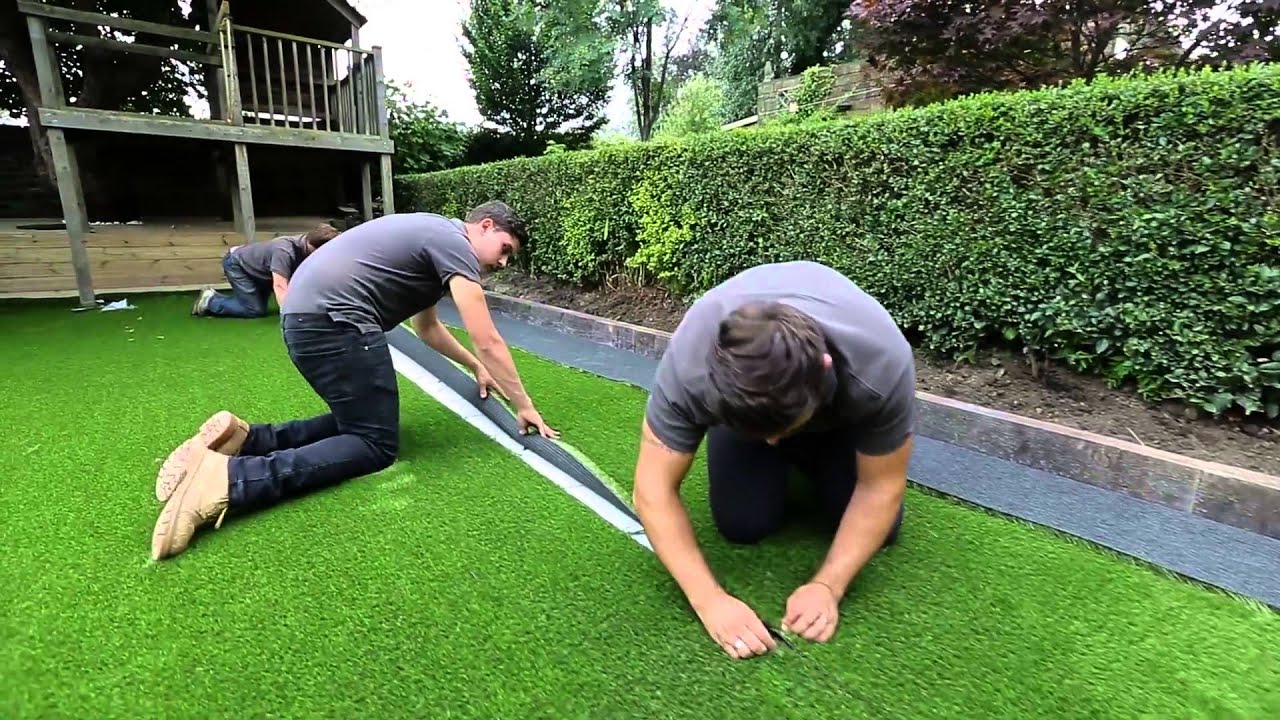
Nylon putting turf is stretched tight across the shaped base and secured at the perimeter. Tension matters on a putting green — a loose surface reads differently under a ball than a tight one. We calibrate the tension across the entire surface before we cut the cups.

Step 5

Cup installation, speed calibration, and fringe

We set cups, add sand infill, and do a putting speed check across all hole locations. Then the fringe turf — a taller pile product at the perimeter — goes in and is seamed to the main putting surface. Final brush and walkthrough with the homeowner.

Service Areas

Artificial Grass Putting Green Design projects commonly support properties in Allen, TX, Mckinney, TX, Frisco, TX, Plano, TX, Fairview, TX, Lucas, TX, Wylie, TX, Parker, TX, Princeton, TX, Melissa, TX.

Putting green questions from Allen golfers

How closely does the ball roll match a real course green?

A well-calibrated nylon backyard green typically runs about a 9 to 10 on a Stimpmeter — comparable to a well-maintained public course green and on the faster end of what most recreational golfers play. We can calibrate toward faster or slower based on your preference. The roll is honest — it does not produce a perfectly consistent bounce like a machine-rolled surface, but it plays very similarly to course conditions.

How much space do I actually need?

We have installed functional putting greens in spaces as small as 300 square feet with two holes. The most satisfying designs are in the 500 to 1,000 square foot range with three to five holes and meaningful contouring. If your backyard can accommodate 500 square feet of dedicated green space, you will have a genuinely useful practice facility.

Does heat affect the putting speed in summer?

Heat does affect the sand infill density slightly, which can affect speed marginally across seasons — a degree or two faster in winter when the infill is firmer, a degree or two slower in peak summer. We account for this in the initial speed calibration by targeting a speed that averages out well across seasons rather than optimizing for one season.

Can we add a chipping zone or bunker?

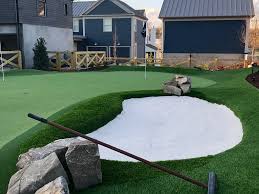
Yes. We can integrate a synthetic sand bunker — using angular silica sand rather than the rounded sand in a real bunker, which plays more consistently — and a dedicated chipping strip at one end of the design. These additions significantly increase the practice value of the installation and we recommend them when the space allows.

Ready to design your Allen putting green?

We will come out and look at the space with you. Most Allen backyard putting green conversations take an hour — we can usually sketch out a design concept on the first visit.